First Draft to Publication: My MPD Thruster Research
A few months ago, I had a research paper that started as an exploration of one question: how does fall voltage affect magnetoplasmadynamic (MPD) thruster performance? At first, I was not sure what I wanted to do with it. Eventually, I decided not to leave it as a project on my computer. I wanted to take it through the process of getting it published.
That decision turned into about four to five months of revision.
Going Back to the Model
The original version of the project used Desmos. It was great for quickly exploring equations, trying different constants, and seeing whether the relationships behaved the way I expected. But for a final paper, I wanted the work to be easier to reproduce, inspect, and extend.
So I rebuilt the model in Python using NumPy for the calculations and Matplotlib for the figures. Instead of changing values manually, I could define the current range, sweep through several fall-voltage cases, and generate the same plots directly from the model. That made the analysis much more systematic and gave me a clearer way to document exactly how the results were produced.
The simplified self-field model uses the idea that electromagnetic thrust scales with the square of discharge current:
T = K I²
With mass flow rate held constant, exhaust velocity follows directly from thrust:
uₑ = T / ṁ
Fall voltage enters somewhere different: the electrical power input. In the model, total discharge voltage is the electromagnetic contribution plus the fall-voltage term. That means it does not directly add thrust, but it does increase the power required to produce that thrust. The efficiency relationship captures that distinction:
η = K²I³ / [ṁ(aI + Vfall)]
That denominator is the important part. A larger fall voltage increases the input-power term without contributing to electromagnetic acceleration, so the predicted efficiency drops.
What the Python Results Showed
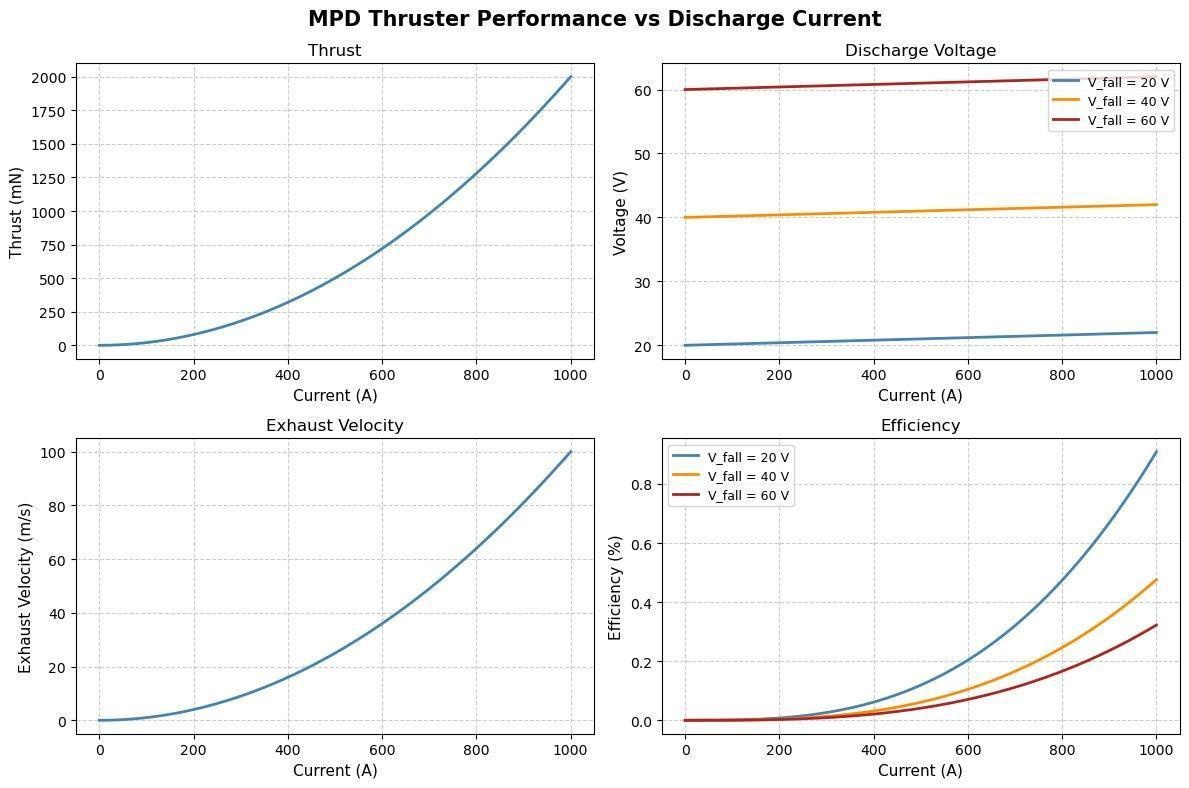
I evaluated fall voltages of 20, 40, and 60 V over discharge currents from 0 to 1000 A. The four plots below are from the Python model included in the published paper.
The result is a useful example of why modeling assumptions matter. The thrust and exhaust-velocity curves overlap for all three fall-voltage values because, in this simplified framework, they depend on current and mass flow rate rather than on the fall voltage itself. The discharge-voltage curves, meanwhile, shift upward as fall voltage increases.
Efficiency is where that electrical loss becomes much more visible. Raising fall voltage from 20 V to 60 V produced roughly a 65–66% reduction in predicted efficiency at both 200 A and 800 A. The model also points to the low-current regime as especially sensitive, because the constant fall-voltage contribution represents a larger share of the total voltage there.
Of course, this is still a simplified analytical model, not a complete simulation of a real thruster. Real MPD thrusters involve nonlinear plasma behavior, electrode effects, erosion, and sheath behavior that can change with operating conditions. The point was not to claim that one equation captures all of that; it was to isolate one assumption and show how much it can influence a performance prediction.
Taking It Through Publication
After revising the paper, I submitted it to the Oxford Journal of Student Scholarship (OJSS). Their process begins with an editorial review to make sure a submission follows the journal’s requirements before it moves into academic review. A manuscript can then receive reviewer feedback, be returned for revisions, and eventually reach a final acceptance decision.
That process made the project feel much more like actual research than a school assignment. Revising the writing, improving the methodology, rebuilding the computational model, and meeting the standards expected by a journal took considerably more work than writing the first draft.
One part I found especially valuable was learning to separate a result from its assumptions. The headline result—that fall voltage strongly changes predicted efficiency without directly changing thrust in this model—only makes sense because the model holds other factors fixed. Being explicit about those boundaries is just as important as producing the graph itself.
Published
“Fall Voltage as a Key Parameter in MPD Thruster Performance Modeling” was published in the August 2026 issue of OJSS on August 13, 2026. The published paper includes the Python-based model and analysis.
You can read the published article here:
The paper is also available through its DOI: 10.65161/recIG1EOrlKXYXbwO